
Part 1: Project Success vs Project Outcome — Why They’re Not the Same
- Mzukisi Qunta
- Apr 14
- 3 min read

Most teams think they understand success. Deliver on time, stay within budget, meet scope. Simple, clean, measurable, and incomplete.
What’s usually being measured there is project outcome, not project success. The two are often treated as the same thing, but they’re not. That gap is where a lot of problems sit unnoticed until it’s too late.
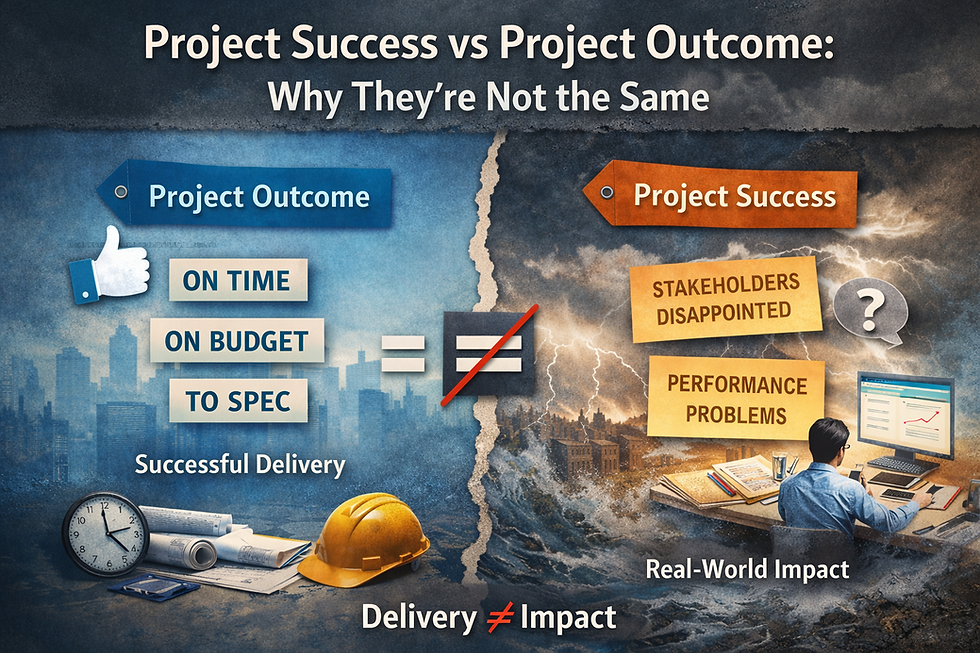
Project outcome is straightforward. It’s what gets delivered. A building completed, a system installed, a model issued. It’s tied to scope, cost, schedule, and quality metrics. These are important. They give structure and accountability, and without them, projects drift.
But success sits somewhere else entirely. It lives in how that outcome performs over time, and how different stakeholders experience it.
A project can hit every metric on paper and still be seen as a failure. You see it in buildings that meet all specifications but are difficult to operate. Systems that are technically correct but unusable. Designs that pass coordination but create problems downstream during construction or maintenance. None of those failures show up clearly at handover.
This is where the distinction matters.
According to project management thinking, project success is inherently subjective and evolves over time. Different stakeholders judge success differently, and those judgments change as the project moves through its lifecycle . What looks like success during delivery can look very different six months into operation.
That’s uncomfortable because it challenges the idea that success can be fully defined upfront.
From an ISO perspective, this aligns closely with the idea of fit for purpose. Delivering a compliant product is not the same as delivering a product that performs effectively in its intended environment. ISO systems push for consistency and control, but they also require an understanding of context and intended use. That’s where outcome and success start to separate.
A useful way to think about it is this:
Outcome asks, did we build it right?
Success asks, did we build the right thing?
Both matter. But most projects over-focus on the first because it’s easier to measure.
The risk is that teams optimise for delivery performance while missing long-term value. That’s how you end up with technically successful projects that don’t hold up in the real world.
Case Studies
Case Study: Office Fit-Out Delivered Perfectly… On Paper
A commercial office fit-out was delivered exactly as planned. On time, within budget, all compliance boxes ticked. Six months later, the cracks showed.
The layout didn’t support how teams actually worked. Collaboration suffered. Spaces were underused or misused. Staff adapted, but productivity took a hit.
Nothing was technically wrong. The design matched the brief.
The issue was that the brief didn’t reflect real usage. Stakeholder input was captured early and locked in, instead of being tested and refined.
The outcome was correct. The success wasn’t.
Case Study: BIM Coordination That Didn’t Translate to Site
On a large construction project, the BIM model was fully coordinated. Clash detection reports were clean. Coordination meetings were structured and consistent. From a digital delivery standpoint, everything looked solid. Once construction started, issues appeared.
Installations that worked in the model became difficult on site. Access zones were too tight. Sequencing wasn’t practical. Trades had to adjust in real time, leading to delays and rework.
The model was technically correct. But it didn’t fully account for how work would actually be executed.
The gap wasn’t in coordination. It was in context.
The model answered, “Is this clash-free?”It didn’t fully answer, “Can this actually be built efficiently?”
References:
Laufer, A. (2012). Mastering the leadership role in project management: Practices that deliver remarkable results. FT Press.
Vaill, P. B. (1996). Learning as a way of being: Strategies for survival in a world of permanent white water. Jossey-Bass.
Womack, J. P., & Jones, D. T. (2003). Lean thinking: Banish waste and create wealth in your corporation. Free Press.
University of Wisconsin-Madison. (n.d.). Technical project management course material


Comments