
Part 3: Why “On Time and On Budget” Can Still Mean Failure
- Mzukisi Qunta
- Apr 16
- 4 min read

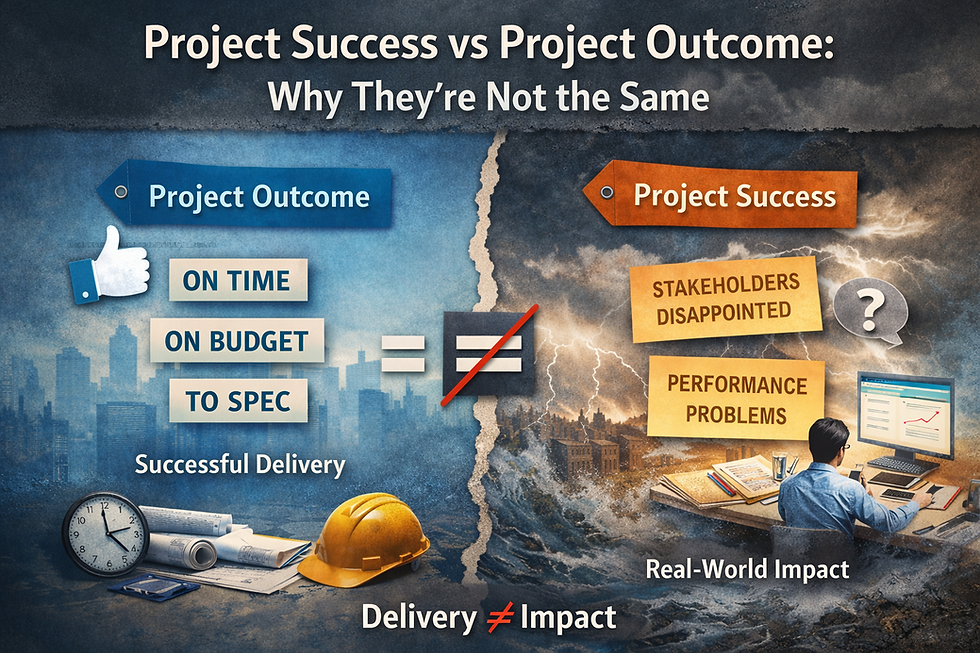
“On time and on budget” is still one of the most widely used measures of success. It’s also one of the most misleading. It tells you how well the project was controlled. It doesn’t tell you whether the project was worth doing, or whether it delivered lasting value.
This becomes clearer when you look at projects across their full lifecycle. A project doesn’t end at handover. That’s just the transition point. The real test starts during operation, when decisions made during design and delivery begin to show their consequences.

In construction, this is where the gap becomes obvious. Operating costs, maintenance challenges, user experience, adaptability, and long-term performance all start to matter more than initial delivery metrics. The material highlights that the operating phase is often the most expensive part of the lifecycle . That alone should shift how success is defined.
A building delivered cheaply but expensive to maintain is not a success. A system delivered quickly but requiring constant rework is not a success. These are outcomes that looked efficient during delivery but created waste over time. There’s also the issue of changing perception. Stakeholders evaluate success differently depending on when you ask them. During construction, disruptions might make a project feel like a failure. Once complete, the same project might be seen as highly successful if it improves performance or usability.
Success is not a fixed point. It’s something that emerges over time.
This is why narrow definitions of success create risk. They encourage short-term optimisation at the expense of long-term performance. Teams focus on hitting deadlines and budgets, sometimes by cutting corners that only become visible later.
A more balanced approach looks at success across multiple layers:
Delivery performance (time, cost, scope)
Functional performance (does it work as intended?)
Lifecycle performance (how does it perform over time?)
Stakeholder satisfaction (does it meet real needs?)
From a project management standpoint, this requires broader thinking. From an ISO standpoint, it aligns with continuous improvement and lifecycle awareness. From a practical standpoint, it simply reflects reality. Projects don’t exist in isolation. They exist in systems that continue long after the project team has moved on. If success is only measured at the point of delivery, you’re only seeing part of the picture.
Case Study: Residential Development with Long-Term Cost Issues
A residential development was delivered ahead of schedule and slightly under budget. From a project controls perspective, it was considered a strong performance.
Within the first year of occupation, issues started emerging. Waterproofing failures led to recurring maintenance. Poor detailing in certain areas required rework. Energy efficiency assumptions made during design didn’t hold up in actual use, resulting in higher utility costs for residents. None of these issues were visible at handover.
The project met its delivery targets, but decisions made during design and construction shifted costs into the operational phase. What looked efficient during delivery became expensive over time. The key issue here was short-term optimisation.
In order to meet budget constraints, certain materials and detailing approaches were accepted because they met minimum requirements. They were compliant, but not necessarily robust. The long-term implications weren’t fully considered because the project was measured against immediate delivery metrics. This ties directly into lifecycle thinking. The operating phase is where most costs are incurred, yet it receives the least attention during decision-making.
From a reporting perspective, the project succeeded. From a lifecycle perspective, it created avoidable inefficiencies. That’s the limitation of using “on time and on budget” as the primary definition of success. It measures how well the project was delivered, not how well it performs.
Conclusion
“On time and on budget” gives a sense of control. It tells you the project was managed tightly, that decisions were tracked, and that delivery stayed within agreed limits.
But it doesn’t tell you whether those decisions were the right ones. The examples make that clear. A residential development can meet every delivery target and still create long-term cost problems. An ISO-compliant system can pass every audit and still fail the people using it. In both cases, nothing was technically wrong. The issue only becomes visible when the project moves into real use. That’s the limitation of short-term thinking.
Projects are often measured at the point where they are easiest to evaluate, not where they are most meaningful. Handover becomes the finish line, even though it’s really just the starting point of performance. What happens after that, how the asset operates, how the system is used, how costs evolve, is where success is actually tested.
From a lifecycle perspective, this shifts the conversation. Decisions made during design and construction don’t disappear once the project is complete. They carry forward into maintenance, usability, adaptability, and cost. When those factors are not considered early, they show up later as inefficiencies.
From an ISO perspective, this is where the principle of continuous improvement becomes practical. Compliance is not the goal. It’s the baseline. The real objective is performance that holds up over time.
So the question changes.
It’s no longer just “Did we deliver within constraints?”. It becomes “What did those decisions create over the life of the asset?”
That’s a harder question to answer, but it’s the one that actually matters.
References
Laufer, A. (2012). Mastering the leadership role in project management: Practices that deliver remarkable results. FT Press.
Morgan, M., Levitt, R. E., & Malek, W. (2007). Executing your strategy: How to break it down and get it done. Harvard Business School Press.
Womack, J. P., & Jones, D. T. (2003). Lean thinking: Banish waste and create wealth in your corporation. Free Press.
Vaill, P. B. (1996). Learning as a way of being: Strategies for survival in a world of permanent white water. Jossey-Bass.
University of Wisconsin-Madison. (n.d.). Technical project management course material

Comments